Friday, August 14, 2020

Correction to Identity of Our 5th Great-grandfather Raney/Rainey

Our 5th great-grandfather was not Peter Rainey, as I originally thought, but his brother William Rainey (1750 Albemarle Parish, Sussex Co., VA - 1799 Northampton Co., NC). Never quite comfortable with Peter as our ancestor, and unable to identify his wife's family through DNA matching, I took an in-depth look at Peter's brother William. He did have a son named James, but because they were living in Northampton County, North Carolina, why would James have traveled up to the old home grounds of Sussex County to marry Martha Parham in 1800? Why not marry the girl on the next plantation? We have strong DNA matches to descendants of the Parhams, so I'm certain of that match.

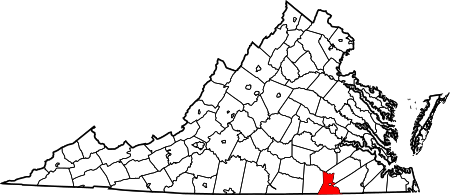
Sussex County, Virginia

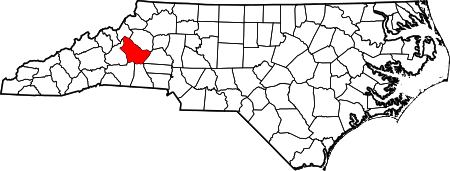
Northampton County, North Carolina

In an experimental mood, I changed our family tree by making our 4th great-grandfather, James Rainey (c1775 - 1838/40 White Co., TN), the son of Peter's brother William Rainey and his wife Catherine Hall Vaughan (1745 (VA or NC - 1836 Warren Co., NC). It then fell into place. DNA matches I couldn't figure out turned out to be to the descendants of Catherine Hall Vaughan's ancestors, the Vaughans (who came out of the Surry/Sussex counties of Virginia to Northampton County) and the Poindexters. I feel certain this is correct. It doesn't change the identity of our 6th great-grandfather, another William Rainey (c.1722 Surry [future Sussex] Co. - 1765 Sussex Co., VA).

So, our new-to-us 5th great-grandfather, William Rainey, was born in Albemarle Parish, Surry [future Sussex] County, Virginia Colony on 26 January, 1750, the 2nd child and first son of William and Mary Jackson Rainey
Greensville County, Virginia

Earlier, in 1742, William's grandfather, Thomas Jackson (1793-1751) (father of his mother Mary Jackson Rainey and our 7th great-grandfather) patented about 300 acres in what became Greensville County, which he transferred to the Wainwrights, who failed to pay quit rents on the property, as did the Jackson heirs, Peter Jackson and his sister and her husband Mary Jackson (1724-1774) and William Rainey (1725-1768), so that in 1766 Mary's and Peter's brother Ralph made suit and obtained the right to the property, which he assigned to his nephew, our 5th great-grandfather, 16-year-old William Rainey. The property was re-surveyed and found to contain 312 acres rather than 300. Perhaps William sold off some of that land, but he kept at least seven slaves on a plantation of 110 acres there, even after he moved across the border to Northampton County, North Carolina, probably because that was where his bride's family the Vaughans lived. The North Carolina Provincial Congress passed a ban on importing slaves from Virginia into North Caroline in 1774, believing increasing the number of slaves in the colony would increase the number of runaways and free blacks. We'll get back to that Greensville plantation a little later.

Catherine Hall Vaughan's mother, another Catherine Hall Vaughan, our 6th great-grandmother, died shortly after her daughter's 1745 birth; her father William Vaughan (1722-1794) remarried and provided her with numerous half-siblings.

 William and Catherine had sons Hall, William, James (our 4th great-grandfather), Edmond, Thomas Hall, Daniel, Polly, Betsy Patsy, Catherine Hall, and Maria Ann, all named in William's will in that order, so we'll assume James was the third son, although at least one sister may have been older. 

Fatally ill, William prepared his will in March 1799 in Northampton County. It's an interesting Last Will & Testament, if only to show the family's lifestyle. Most men gave their wives control of their property only if they remained widows, normally indicating it be sold for the children's benefit if the widow remarried, but William didn't do that, and it would  cause trouble in the future. He left his personal and real property to Catherine, which included the 110 acres in Greensville, Virginia, and the seven slaves Cherry, Betty, Violet, Ellick, Lilly, Harry and Serena.  Northampton County was becoming a race horse breeding area, home to the famous stud Archie, ancestor of Man o' War. William left Catherine two horses, a gray and a sorrel, nine head of cattle and twenty head of hogs. He designated that she obtain for the three youngest sons, Edmond, Thomas Hall, and Daniel, each a horse when they reached the age of twenty. Because James was not included, we can assume he was already age twenty or older, which would put his date of birth at 1775 or earlier. 

The household items were nothing of value: four beds and furniture (bedding); two tables; seven chairs; one riding chair and harness; four iron pots; a kettle; a Dutch oven; three pewter dishes; eight plates; three basins; six spoons; six earthen dishes; 18 earthen plates; two teapots; one tea kettle; three earthen bowls; small quantity cups and saucers; one ox cart; five plow hoes; five weeding hoes; three hilling hoes; two grubbing hoes; two chests.

When the youngest son Daniel reached twenty years, William's will decreed that "the whole of my estate after the sons having had their horses, to be equally divided among my wife Catherine and all my surviving children" in "equal proportions." He then listed the ten children. He named Catherine and his son William executors. William's will was probated at the 1799 December court of Northampton County.

William Rainey's actual signature on his 1799 will, spelling it Raney. When the clerk copied it into the county Will Book, he changed the spelling to Rainey.
 The following spring our 4th great-grandfather, James Rainey, traveled up to Albemarle Parish, Sussex County, Virginia, where his father William had been born 50 years earlier, perhaps where he also had been born, and married Martha Parham on 3 April 1800. As a third son he had little to offer. Many of his siblings were still children - his sister Maria Ann born just before his father's death - so there was little chance of the plantation and slaves in Greensville County being sold and the proceeds divided. All we know at present is that James appears on the 1810 census for Pulaski County, Kentucky, with a wife and family. I doubt he and Martha made the move alone, but for now we don't know what extended family members, if any, traveled with them to Kentucky. 

About 1811, back in Northampton County, William's widow Catherine married Benjamin Putney. She yet had minor children in her household. Her son, Thomas Hall Rainey, was an ambitious man, who had married in February 1808 Elizabeth Gray, daughter of a wealthy plantation owner. Family myth says that after her father forbade the marriage, they eloped over the frozen Roanoke River, no doubt on a fine horse. It appears he feared his new stepfather was up to no good regarding the plantation in Greensville County, so he entered his mother's house and carried off the paperwork in the form of bonds, which were required in any sale of that property. Benjamin Putney and his mother sued him for the return of the paperwork, which Thomas claimed in a deposition, after swearing on the "Holy Evangelists" (the New Testament), he'd taken to protect the rights of his brothers and sisters and his own claim on his father's estate. Eventually the suit was settled and he returned the papers. Thomas Hall Rainey owned a mill for wheat and possessed slaves to work his cotton fields. He also was a money lender as some wealthy men were, banking not trusted by many. After a long illness - his doctors' bills were enormous for the time, running into the hundreds of dollars - he died in 1826, leaving his estate in trust for a son and three daughters, with  Elizabeth as guardian. Elizabeth insisted the children be sent to private boarding schools, the expenditures for which she had to report to court-appointed guardians after her own guardianship was terminated for her being a spendthrift.  And because of it we have a record of how an upper-crust daughter, such as Nancy Rainey, our fist cousin 5X removed, then about age 11, was outfitted for boarding school in 1829.

c1830 children's clothing
All clothing was handmade. Yards of various types of cloth were required: Indian cotton, cambric, calico, check cloth, flannel, muslin, dimity, linen, lace, ribbons; spools and balls of threads; bunches of pins. Other items were: a cashmere shawl; a veil; a hat and a band box; leather shoes and a finer pair of Morocco leather shoes; boots; a bandanna handkerchief and a silk handkerchief; silk gloves; three pairs of stockings and a pair of garters and belt; a fine comb [its teeth close together, likely for combing out lice nits]; 2 tortoise side combs; one strand necklace; a pair of scissors and scissors chain; a silver thimble; a belt clasp; a quire of paper; ink powder; a pen knife. The cost of board and room itself for Nancy was $40.00.
Warren County, North Carolina

Our 5th great-grandmother Catherine's husband, Benjamin Putney, died in 1825. In the 1830 census, Catherine was living at Six Pound in northern Warren County, North Carolina, next door to her daughter, Catherine Rainey Riggan. In fact, three of William and Catherine's daughters married Riggan brothers.  Catherine died in 1836. If our James's last brother Daniel was born in 1793, he would have reach age 20 in 1813, received his horse, and then the Greensville County plantation and slaves would have been sold, and the profits dispersed to all ten children. Did our James get his share? And how would he get it in Pulaski County, Kentucky?

 W-e-l-l, via the U.S. Postal Service, of course. No rural delivery was yet available, but there was a post office at a home or a store by 1803 in Somerset, James' nearest town. No postal money orders were available until the Civil War, but monies could be sent through the mail. 

Below is a video "Save Our Post Office" produced by People for the America Way, the song sung back in 1958 by Alabama shape note singers, a very old manner of singing in America. 

As of June 2020, 671 high-volume mail processing machines were ordered removed from sorting facilities across the U.S.

Be aware. The United States Postal Service is enshrined in the Constitution as a core priority of the federal government because it provides an irreplaceable service. It’s part of the lifeblood of our communities. By making sure that all Americans, regardless of where they live, can be in contact with one another, the Postal Service knits together the fabric of our community. It unites all of us.

With startling reports that the USPS is cutting back on services because they are stretched for revenues, we simply can’t afford for the USPS’s role to be diminished, particularly as we become even more reliant on meeting our needs in this time of the COVID-19 crisis.

Sunday, July 26, 2020

Our Raney Family Ancestors: Were They Slaveholders?

1828 Slave Auction advertisement, Richmond, Virginia

 Our cousin, Pat Raney, told me he once asked his dad, Paul Raney, whether our ancestors had possessed slaves, and Uncle Paul said, "No." Uncle Paul was partly right, but his knowledge of our ancestors went back only so far.

In our Raney family ancestry, we have four distinct groups: Grandma Mary Smith Raney's French family; Nancy Dyson Raney's ancestors, who originally settled in Maryland Colony before heading west into Kentucky and finally over the Ohio Rivier into southern Indiana; Nancy Jane Dougan Rainey's ancestors who came from Ulster to Pennsylvania Colony, then down to North Carolina, before resettling in Tennessee and then in southern Indiana; and our Rainey ancestors, some of the earliest of Virginia Colony's landholders. 
Slave and free states in 1854. Indiana was a free state.

Our grandmother Mary Smith Raney's people came from the Franche-Comté part of eastern France in the 1830s and the early 1850s to settle in Darke and Shelby counties, Ohio, and later in Wilson County, Kansas, where Grandma met and married in 1910 our grandfather Frank Whitman Raney. Grandma's family were never slaveholders. Nevertheless, Grandma absorbed either the Kansas view or more-likely Grandpa's attitude toward African-Americans. When Mom came home from Alcott school in Spokane to say a Negro girl was in her third grade, Grandma admonished her, "Be nice to her, but don't play with her." Mom told me she felt bad seeing the little girl standing on the edge of the playground watching the children play, never invited to join them, but Mom would never have disobeyed her mother or suffer the ridicule of her fellow students.
Northern Ireland was the temporary home from which most of our Scots ancestors came.
In the 1730s the ancestors of Frank Whitman Raney's grandmother, Nancy Dougan Rainey, came to Pennsylvania from Ulster (Northern Ireland). By 1764 a large family group emigrated down to North Carolina Colony, in time for the American Revolution. It was a bloody conflict of attrition in which Carolina settlers took sides, forming militias and waging war against one another. Our 5th great-grandfather, Colonel James Dougan (1756 Lancaster Co., PA - 1837 Franklin Co., TN) was a merciless leader in this rebellion, making a name and rank for himself, afterward  granted 1000 acres in western Tennessee for his service - land he never saw. His mother's people, the Kerrs, and his wife Hannah's family, the Grahams and Sharps (her father, our 6th great-grandfather Edward Sharp [1744 Lancaster Co., PA - 1789 Randolph Co., NC], also a colonel in the American Revolutionary War), came to Pennsylvania from Donegal, Monaghan, and Tyrone counties in the north of Ireland, then down to North Carolina. Staunch Scots Presbyterians, their people had left Scotland for resettlement in northern Ireland in the early 1600s during the reign of James I, as the British crown pressured the lowland Border Scots to resettle there as it forced Catholic Irish to the west.

In the North Carolina census of 1790, Col. James Dougan possessed no slaves, although his brother Thomas possessed nine. After brother Thomas' death in 1795, and before1820, numerous of his offspring eschewed slavery and moved their families to Indiana so their children would not to be "contaminated" by it.  Col. James Dougan's son, James Dougan, Jr. (1782 Randolph Co., NC - 1827 Dyer Co., TN),and Anne Cross Dougan (died 1827 Dyer Co., TN), our 4th great-grandparents, settled on his father's bounty land in Dyer County, Tennessee, shortly before their deaths and likely did not possess slaves. 

However, Anne's father, Zachariah Cross (1761 Baltimore Co., MD - 1838 Illinois), another 5th great-grandfather, who served in the Revolutionary War, possessed 2 slaves in the 1810- and 3 slaves in 1820 censuses in Logan County, Kentucky, and 4 slaves in the 1830 census of St. Louis County, Missouri.
1855 Slave Sale in Lewis County, Kentucky
Direct ancestor of our great-grandmother, Nancy Dyson Raney (1867 IN - 1938 Gibson Co., IN), was our 5th great-grandfather Maddox Dyson (1744 Charles Co., MD - 1814 York Co., SC), a Revolutionary War soldier, who possessed one female slave, 56-year-old Prilly, in 1776, and two slaves in the 1790 census for Montgomery County, Maryland. He must have taken them with him when he moved down to York County, South Carolina, for his 1800 census there shows possession of two slaves. When he died in 1814 in York County, he left his personal property to his second wife, mother of his last three children. It was unnecessary for him to mention any slaves, for they were considered "personal" property.
1857 Maryland award notice for the capture of a runaway slave
Maddox Dyson's son by his first marriage, our 4th great-grandfather, Bennet Dyson (1768 Montgomery Co., MD - after 1840 Union Co., KY) possessed no slaves in the 1790 census for Montgomery County. Between 1800 and 1810 he moved his family to Henderson County, Kentucky, and farmed without slaves. His last census of 1840 in Union County indicates no slaves. His daughter Ann married a man in 1816 who possessed 8 slaves in the 1830 Kentucky census, so we can't say that Bennet inculcated anti-slavery beliefs into his children. His son, William Hill Dyson (1801 St. Mary's Co., MD - 1870 Warrick Co., IN), our 3rd great-grandfather, married in 1826 Alice Julian, daughter of  Methodist minister Samuel Denton Julian (1780 Rutherford Co., NC - 1851 Warrick Co., IN) and moved with that family to southern Indiana by 1830. Neither he nor his father-in-law possessed slaves.

This 4th great-grandfather, Samuel Denton Julian, married Mary Condry in 1806 in Rutherford County, North Carolina. Her father, Claiborne Condry (b.1754 Rutherford Co., NC) was not a slave-owner. Only one of his four sons acquired slaves after he resettled to the north in Chesterfield County, Virginia.

William Turpin (1650 England - 1685 Somerset Co., MD), our 8th great-grandfather, arrived in Maryland in 1661. A few generations later, Solomon Turpin, our 6th great-grandfather, left Maryland Colony for what would become West Virginia, where he died in about 1779. Neither his son Moses (1757 future WV - 1816 Pulaski Co., KY), our 5th great-grandfather, nor his other three sons, possessed slaves.
Pulaski County, Kentucky
Our 4th great-grandfather, Moses Turpin (1812 Pulaski Co., KY - 1892 Decatur, IA) left Kentucky for southern Indiana, where he married Frances Utterback/Otterbach in 1834. "Frankie" as she was called was descended from founders of the first German colony, Germana, established in Virginia in 1714 to mine for silver and iron. They soon switched to farming. This family owned no slaves. Their daughter Elizabeth "Ella" Turpin (1841 Owen Co., IN - bef. 1870 IN) married, in 1858, Whitman Hill Dyson in Warrick County, Indiana, and they became our 2nd great-grandparents.

Burke County, North Carolina

Our 6th great-grandfather, Arthur Erwin (1738 Bucks Co., PA - 1821 Burke Co., NC), a captain in the Revolutionary War, was an ancestor of our 2nd great-grandmother, Nancy Dougan Rainey, who married Everett Raney/Rainey in 1865 when he returned from serving three years as a Union soldier in the American Civil War. The Erwins, originally from Scotland and Presbyterian, arrived in Pennsylvania from Ulster about 1738 and thence down to North Carolina before the outbreak of the rebellion. In the 1790 census he possessed nine slaves. Here are selected parts of his Last Will & Testament:

Will of Arthur Erwin, Burke County NC, 27th of August, 1821:  In the name of God Amen. I Arthur Erwin of the County of Burke in the State of North Carolina . . . hereby devise and bequeath unto my well beloved wife Margaret Erwin . . . my Negro woman Linda and girl Sally, daughter of Nancy, during her life and no longer and then to be divided as hereafter directed. . . I do devise and bequeath unto my son William my Negro man Frank to him and his heirs forever. My will is and I do devise and bequeath unto my son James my Negro man Jim, a sorrel mare and sixty dollars, which two latter articles have been long since delivered to him and to him and his heirs forever. . . My will is and I do devise and bequeath unto my son John a Negro man called Ben which I delivered him long since to him and his heirs forever - My will is and I do devise and bequeath unto my grandchildren, children of my [deceased] son Alexander [our 5th great-grandfather], my Negro man Jo which I delivered to my son in his lifetime, to them and their heirs forever - My will is and I do devise and bequeath unto Arthur, Robert, William [our 4th great-grandfather], Cyrus and Marcus, the five sons of my son Alexander Erwin, all that tract of land situated on the forks of the Upper Creek called the Harbinson place containing three hundred acres to them and their heirs forever, share and share alike - . . . I do devise and bequeath unto my daughter Polly Patton the two Negro women I gave her heretofore named Nelly and Bina and their increase to her heirs forever and also a Negro girl Sally left to my wife during her life and at the death of my wife to my daughter Polly Patton to her and her heirs forever. My will is and I do devise and bequeath unto my grandson Adolphus L. Erwin my Negro woman named Mary and her increase which Negro woman I delivered sometime ago to him and his heirs forever - . . . My will is and I do devise and direct that all my Negroes not disposed of in this will and by me held be valued by men chosen indifferently as to relationship (if they cannot be divided without) and allotted equally among my three sons as to their value, William, James and John, and kept by them, or if they should think proper to sell them to let those of the family who may be able to purchase them have them as it is my wish that they should not go out of the family, the property when allotted to be the holders of the said John, James and William and their heirs forever.. . .  In testimony whereof I have hereunto set my hand and affixed my seal this 18th day of February A D 1819 ad 43 year of American independence. . . .

Arthur's son, our 5th great-grandfather, Alexander Erwin, possessed slaves at his death in North Carolina in 1816, but his son William Erwin, our 4th great-grandfather (1790 Burke Co., NC - 1850 IN), did not. He may have left North Carolina before his father's death, for he married Elizabeth Whittinghill in 1816 in Ohio County, Kentucky. They settled by 1818 in southern Indiana.  Elizabeth Whittinghill's father Peter, who served in the American Revolutionary War, and her mother's family, the German Gabhardts, who arrived in Philadelphia in 1731, then moved down to Augusta County, Virginia, and later to Lincoln County, Kentucky, did not possess slaves.

Our 4th great-grandfather, John Roberts (c.1771 Fincastle Co., VA - 1857 Pulaski Co., KY) did not own slaves. His wife Jane's Scots-Irish Patton family, who had come from County Donegal in the early 18th century to Pennsylvania, then down into western Virginia, did not appear to possess slaves, either. John Roberts' daughter, Milly Roberts and James Rainey married in 1832 in Pulaski County to become our 3rd great-grandparents. They did not posses slaves. Nearly all of these branches of ancestors left Northern Ireland and Germany for economic reasons, wanting a life of farming the basics so they could rear their families without want.
 
And that brings us to our Rainey/Ranye forebears and their kin, the early English planters of Virginia. So many Virginia records were destroyed in courthouse fires before and during the American Civil War, few records of our ancestors' Last Wills & Testaments remain extant.  These direct ancestors lived in Tidewater Virginia for two hundred years - from about 1620 to shortly after 1800, when our newly married 4th great-grandfather James Rainey (c1778 Sussex Co., VA-1838/40 White Co., TN) and his bride Martha Parham Rainey (c. 1780 Sussex Co., VA -1817/20 Pulaski Co., KY) set off from Sussex County, Virginia, for Kentucky without slaves.

James' father, William Rainey (1750 Sussex Co., VA - 1799 Northampton Co., NC), our 5th great-grandfather, possessed six slaves at the making of his will in 1797, which he kept on a plantation he owned in Greenville County, Virignia, not where he lived in Northampton. He named them in his will: Cherry, Betty, Violet, Ellick, Lilly, and Harry.


Our 4th great-grandmother, Martha Parham was the product of Stith Parham's second marriage to Lucretia Sturdivant, widow of a Parham cousin. Neither parent lived to see Martha married to James Rainey. In the 1790 census Stith Parham possessed 30 slaves. The following year Stith gifted to his son Matthew Anderson Parham the "following Negroes: Rodger, Tom, Ephraim, Hartwella, Pat, Ussey, Charles, Julley, Argain, Cate, Fred, Sarah, Sucy and Scott." In Stith's will of June 1793 he described himself as a citizen of South Carolina, but presently back in Virginia. He left his plantation in South Carolina and all his slaves, but for two, to his son Stith, Jr., who had possession of them, and left the two named slaves, Nick and Beck, and the remnants of his Virginia lands , to son Matthew Anderson Parham.

Sussex County, Virginia, carved out of Surry County in 1754, both having been part of Prince George County earlier.

Stith Parham was not a self-made man. His father William Parham (1696 Virginia -1758 Sussex Co., VA), our 6th great-grandfather, was a cotton grower, as attested by a large amount of cotton seed in his probate inventory. Sussex County on the Virginia-North Carolina is the northernmost area for growing cotton. It was labor intensive, as was the tobacco raised by most of our Virginia ancestors. William left his wife Anne Stith Parham the use of the plantation during her lifetime and most of his 11 slaves. He left the plantation and some slaves to his son Thomas. To his son Stith Parham, our 5th great-grandfather, he left some slaves and the lands he owned in Dinwiddie County, which Stith must have sold, for he remained in Sussex County.

 Stith Parham's wife, Lucretia Sturdivant Parham, was the daughter of  Henry Sturdivant (1706 Surry Co., VA -  1772 Sussex Co., VA), our 6th great-grandfather, who made his will shortly before his death, leaving his son John the land he lived upon containing 165 acres, one negro woman Cresse and her children Phebe and Cloe and one negro girl Sally, which slaves the son had in his possession. Also, one negro named Old Jemmy and a negro boy named Stephen. 

I'm unable to locate the will of our 6th great-grandfather, William Rainey, Jr. (c.1722 Virginia - after 1769 Sussex Co., VA), but I have found the will of his father, our 7th great-grandfather William Rainey, Sr. (c.1690 Virginia - 1768 Sussex Co., VA ) of January 1766. The pertinent parts are:

In the name of God, Amen, I William Rainey . . . give to my Son William Rainey [our 6th great-grandfather] . . . a Negro man called Hector to him and to his heirs for ever . . . I give and Devise to my Son Nathaniel Rainey . . . a Negro man named Caesar . . . to him and his heirs for Ever . . . I Give and Devise to my Daughter Mary Baley one Negro woman named Jane and her increase to her and her heirs for Ever . . . .

Fayette County, Kentucky advertisement offering cash reward for a runaway slave.

When William's father, our 8th great-grandfather, William Rainey/Ranye (c1660 Belfast, Ulster - 1722 Prince George Co., VA) [whose land became part of Surry and later Sussex Co.] made his will in 1722, he made no disbursement of slaves. Did it mean he possessed no slaves, or that he had already gifted them to certain of his children? He was a merchant, but also bought and sold land.

 
Going farther back in our ancestry, a pair of ancestors of Martha Parham were our 9th great-grandparents Christopher and Mary Addy Branch, who arrived at Jamestown in 1620 aboard the ship "London Merchant."  Christopher Branch (1598 England - 1681 Henrico Co.,VA) was a tobacco planter, a tobacco viewer, and a burgess. At the time of making his will in June 1678, he possessed an English indentured servant, Joab, and a slave referred to as "the Negro." Half of the "Negro's" labor was to go to his three orphaned grandsons to help build their houses and clear cornfields sufficiently fenced to keep out hogs and cattle.

Our distant cousin, President Thomas Jefferson

It is through the Branches and the Ishams that we are related to President Thomas Jefferson, our 3rd cousin 7x removed, who owned 130 slaves at his death in 1826. He was so in debt that all of his slaves were sold, except Sally Hemings and her family.  It's interesting to note that Jefferson's grandson, Thomas Jefferson Randolph (1792-1875), our 4th cousin 5x removed, after the Nat Turner slave rebellion of 1831, introduced a post nati emancipation plan in the Virginia House of Delegates that would have provided for gradual emancipation of children born into slavery after they served an apprenticeship and came of age. It was defeated. Randolph, who was Thomas Jefferson's executor, was the person who told the historian in the 1850s that the slave Sally Hemings, half-sister to Jefferson's dead wife Martha, was not his grandfather's mistress and the mother of his children, but that Randolph's uncle had fathered those children who so resembled Jefferson. That was believed until DNA has proved otherwise.

The Virginia House of Burgesses passed a law in 1662 that  included the principle of partus, to prevent slaves with English fathers from claiming freedom. Other colonies quickly adopted the principle. It held that "all children borne in this country shall be held bond or free only according to the condition of the mother," meaning that white fathers were no longer required to legally acknowledge, support, or emancipate their children by slave women. Men could sell their children or put them to work.Virginia planters encouraged their slaves to produce offspring, masters, their sons and overseers assisting in the procreation. By 1790 Virginia reached a point where the slave population was 292,627 compared to the white population of 442,117.  It was about this time that plantation owners began selling their surplus slaves "down the river," to the cotton fields of the Deep South. 

Lexington, Kentucky advertisement wanting to purchase slaves, likely to be sold into the cotton fields of the Deep South.
After the American Revolutionary War, Methodists and Quakers preached that slavery was wrong and pressed their planter neighbors to release their slaves. One such Sussex County planter, a nephew of our 5th great-grandfather Stith Parham, who was also named Stith Parham (1749 future Sussex Co., VA -1806 Sussex Co.) was baptized into the Methodist church in 1779. He freed some slaves in 1784: 

I Stith Parham of Sussex County Virginia being fully persuaded that freedom is the natural right of all man kind, and that it is my
indispensable duty to do unto all men as I would have them do unto me in the like situation And having under my care 4 Negroes whom I have heretofore held as Slaves of the following names & ages viz't. Simon aged Thirty four years, Cesar Twenty two years, Nanny forty, Tabb thirty seven, I hereby Emancipate and sett free all & every of the above named Slaves and I do for my self my heirs Executors & Administrators Relinquish all my right title Interest and claim or pretension of claim whatsoever either to their persons or any estate they may hereafter acquire. 


And I having also six more Negroes now in their minority of the following names and ages viz't. Fanny aged sixteen, Fanny fifteen, Nathan eleven, Nanny eight, Matt five, Fredrick two, all and every of whom also I hereby Emancipate and sett free. Yet I believe it right for me to act as a guardian over them until the males arrive to the age of twenty one years and the females Eighteen, and I do for myself my heirs Executors and Administrators relinquish all my right title Interest and claim or pretension of claim whatsoever either to their persons or to any estate they may acquire after they shall attain the ages aforesaid which will be the following times Fanny 3rd September 1785, Fanny October 1786, Nathan August 1794, Nanny March 1794, Matt November 1799, & Fredrick September 1803. All the above said Negroes and their posterity to enjoy their full freedom without any interruption from me or any person for by or under me in witness whereof I have hereunto sett my hand & seal this 15th July 1784.

He must have held some slaves back, for later he drew up another writ of emancipation in 1789:  

I Stith Parham of the town of Petersburg being deeply conscious of the impropriety of Negro Slavery, and having in my possession Sundry persons whom I have for sometime held in a State of Slavery do by these presents emancipate the said slaves in the following manner, agreeable to an act of the General Assembly. Gilly (a woman) to have her liberty immediately, Billy (a boy) in the year 1797, Clarissa (a girl) 1799, Cate in 1803, Mary in 1805 and George in 1807. Signed 7 January 1789 and proved in court 1 April 1789.

And again, in 1797 he released the male slave Pick. But he wasn't done yet. In his will of 1806:

My will and desire is that my three young Negroes vizt. Ben, Burwell, and Jimmy have their freedom when they arrive at the age of twenty five years. He transferred the claim he had to these slaves to Edmund Jones and Hill Jones, who ministered from the Methodist Chapel Jones' Meeting House in Sussex County and left $50 to trustees of Jones’s Meeting house toward repairing the same – 15 Jan 1806 – recorded 6 Feb. 1806. This relative must have wrestled with his conscience over and over, for the emancipation of a slave was a money loss, although likely they continued to work for him until they could afford their own land. 

My son Donovan on his father's side is descended from some free people of color granted their freedom from various white planters in Virginia and North Carolina, mulatto children of these planters.

Our Raney family match DNA with numerous distant cousins of African-American descent, whose white forebears are our forebears, too. So, when you see African-Americans marching for equal justice under the law, realize they may well be your kinfolk. 

We'll end with "Carry Me Back to Old Virginny," composed in 1873 by James Bland (1854 NY-1911 PA), one of the best known American black composers of the 19th century. Although born a free man, he understood the plight of unwanted blacks who could not find employment in the northern U.S. after the American Civil War. It was the state song of Virginia from 1940 to 1997. Song performed by Tom Roush. HERE


Sunday, June 21, 2020

In Memoriam: Michele Raney Betts and Virgil Reynolds


Michele Raney Betts in 2018 holding Grandmother Mary Raney's silk parasol, c. 1910
Our family lost two beloved members in late spring.

Michele Raney Betts (Oct. 13, 1952 - May 10, 2020), youngest daughter of Paul and Grace Bernhardt Raney, was born on her uncle Dennis "Denny" Raney's birthday, and so was given the middle name Denise.  She grew up in the Seattle area. I met Michele for the first time at our grandparents Frank and Mary Raney's, 50th wedding anniversary in June 1960. She was seven years old with long golden curls, and I was fourteen. All I knew about her was that she and her sister Paula were tap-dancers.
Michele's high school photo
Our paths crossed again at Frank Raney's funeral in 2012, for which Michele, her husband Mike Betts, her brother Pat Raney and his wife Barbara had driven over. At the funeral luncheon we sat at the same table and, afterward, they came up to our hilltop rural home to sit on the front porch and reminisce about family. It was then I felt kinship for Michele. Two years ago, she, her niece Erin and great-nephew Quinn spent a few days here with Jay and me. Our visit was delightful. Oh, how I wish there had been more days to that visit.
Michele, Kerry (me), Quinn and Erin
Her husband Mike had one word for our bonding. "Blood." Kinship is indeed a foundation for friendship.  She is survived by her husband Mike Betts, her four children, Beau, Michaela, Anne-Marie, and Teresa, numerous grandchildren, and siblings Pat, Sandra, and Paula. You will find her full obituary HERE
Virgil Reynolds, wife Sandra Raney Reynold, her father Paul Raney and his 2nd wife Beth, 2004
For our cousin Sandra Raney Reynolds in Walla Walla, her sister Michele's passing was a double sorrow, for Sandra's beloved husband of 48 years, Virgil Preston Reynolds (1930-April 28, 2020) had died only twelve days earlier at age 89. I met Virgil only once, at my dad's funeral in October 1993, when he and Sandra sat across from Mom and me at the funeral luncheon. Not a good time for a 'getting-to-know you' chat. If I'd seen more of Virgil, I would have discovered we had common interests. He collected antique postcards and haunted auctions and estate sales. I thought of yard sales as an "Easter egg" hunts for delightful discoveries to sell on eBay. I know we would have had much to talk about. My mother, Geneva "Jean" Raney Charbonneau liked Virgil very much and, for me, that is high praise. Virgil's full obituary is HERE
Virgil and Jean Raney Charbonneau 2002
 May all who knew Michele and Virgil feel joy in remembering them.

Thursday, April 2, 2020

François Bourassa Memoir: Part 7 - 1886-87 in Rolette Co., North Dakota


Two-room schoolhouse François Bourassa and his sons built in 1886.
 Here is the last entry of François Bourassa's memoir, written about 1908:

SCHOOL CONSTRUCTION:  On January 26, 1886, our school municipality voted overwhelmingly to borrow $4,000.00 to build three schools, one in the village (no.1), one at our homestead three miles northeast of the village (No. 2) and the third three miles southeast  of the village (No. 3). In March, they announced bids for the construction of the three schools would go to one contractor and, according to the specifications, the keys to be hand-delivered on October 1 for the opening of classes.

That same day I said to Abdalah and Hector, "I think we should make a bid ourselves." They agreed. I was given a copy of the specifications and began the calculations of all the equipment needed for the three constructions. Armed with these calculations and specifications I went to find Mr. Rolston from Kilarney [Manitoba] (a French-speaking wood merchant). He devoted himself to my calculations for an entire day, smoothing out and making some additions, and then added 20 percent to the capital for accidentals (something I had done for only 10 percent). I had a bid prepared by Telletson, leaving blank the capital amount which I added myself, and submitted it to the board on the morning the bids were to be opened. The board was composed of Father Malo and two Anglos. We couldn't hope for any favors. It was certain that in the event of a tie or even roughly close to submissions made by English-speakers, we would be rejected. The board opened the meeting and requested the clerk submit the submissions to them in the order received. The first one he introduced was $2,800. He opened the second, which was Ried and Rowson's $2,375.00; and then opened the third and final one, mine at $1,995.00. The two English-speakers (Taswal and Smith) stared at each other for at least a minute. Taswal turned to Ried, saying, "It’s impossible. There is too much difference in the submissions to ignore. If Mr. Bourassa is willing to make a contract by giving the guarantees, we will give to him." I told them, "It seems to me that the guarantees are easy to give, because in your contract you will have to advance to the contractor one third of the capital, in bulk, and the rest as the work goes on. It seems to me that it's possible for me to give you security for $6 or $7 hundred to prevent you from having ‘a fever’." Taswal said to me, "Will you give us your personal property for security?" "Yes, " I answered. “If it's not enough, I'll give you more." They called on Telletson to have the contract prepared. Arriving to give them security, I said to them: "First take my teams of grey mares harnessed to my wagon." Taswal said, "I think we've had enough." Father commented, "If Mr. Bourassa can’t meet the security, I will fill it in." The contract was signed. It was easy to see that to have the contract, I had to be very tight, a $100.00 lower even, we would not have had it. I was happy to accept Abdalah and Hector as partners. For this we needed an act of association. We went to Hulman's house and had this act prepared. By this act, I became the main contractor. In my absence it would be Abdalah. Any hires would be made by me with their approval. When I worked with my horses, I would be paid $5.00 a day. When I worked only with my hands, $3.00 a day. Abdalah, with his hands only $2.75, and with his oxen, $1.50 more. Hector $2.50 and with his oxen $1.50 more. We paid ourselves wages every week as we would with outside labor. If there was a deficit when the work was finished, we had to fill it with a comparable percentage of what each of us contributed to the work. If, on the contrary, once we finished, we had money left, we would share it, divided by the amount each contributed, always making a division of the block gains of the three partners. This act completed, I signed it. Abdalah too, but Hector didn't want to. Yet he worked there as if he had signed.
Martineau had bought out Brunelle's grocery business.
MEN’S PETTINESS: In the course of these three constructions (a two-room schoolhouse and two one-room schoolhouses), I saw the pettiness men will lower themselves to out of an ambition for gain. I've suffered sometimes from attempted shameful looting. From the beginning, when I was given one-third of my contract amount of $665, it was Martineau who was the treasurer for our schools. When he gave me this amount, he asked, "Do you have any objections, Mr. Bourassa, to pay me the small account you owe to the store?" I replied, "You know this money isn’t mine." "Whose is it if it's not yours?" "God, you know that this is school money, not mine." "Yes, I admit it, but it's not a large amount and I need it." I was ashamed of him and I was outraged. I asked him how much I had in my account. He had prepared the bill in advance. He took it and handed it to me. It was $11.75. I said, "That's fine, give me a receipt." Which he did. I thought I was done with this plundering. I was way-off. The buildings were all raised and grounds of the first one banked [for rain run-off, I suppose] as mentioned by my contract, so I asked him for funds. He replied that there were none. It was a Saturday, we had men to pay and we needed it ourselves. I asked, "How is there no money? Where is the $4,000 school fund? Is it already melted away in your hands?" He replied, "Do you think I keep this money in my pockets? Give them vouchers. They can buy their needs with your vouchers." "They don’t want vouchers, but money, and that's what I'm going to give them." "Well give them some," he said. That's all I could get out of him that day. If it weren't for Telletson, who lent me $50.00 for a few days, I would certainly have defaulted that Saturday. I gave notice of my grievance to the president of the schools, Taswal, who viewed it with severity. That did not stop him from cajoling me, by trying to make me see that we Canadians had to stick together. I told him, "You would commit fraud against the poor working man, giving yourself 15 to 20 cents per dollar on these vouchers. “Vile ratatouille,” [a French vegetable stew; or he played on the word ‘rat’], I told him, “I make them work at a fixed price for money, and that's what they'll get."

When our construction was completed, and even before, he criticized our work as if he knew something about construction, in order to embarrass me on the delivery of the three schoolhouses. Fortunately, I was dealing with a group more honest than he was. Examination of everything was done with great care because Martineau’s criticisms had circulated. The group unanimously complimented my work, to the shame of Martineau, who had made false allegations to the directors themselves.
Hector and Horace Bourassa
We had a lot of waste left - paint, shingles, wood, nails and more. I told Hector, "You have not signed the act of association, so don't do it [now]; you have nothing to do with this waste." He looked at me, but didn’t answer, still worried about there being a deficit. He was paid to the last day. He had been aware there would be an account settlement regarding almost everything. Abdalah knew we would not have a deficit. Finally, Hector replied, "I acted as though I had signed it. I did nothing less than Abdalah. As for the accounts, I did what he did." I said, “Since you expected the same treatment, it would have been more generous of you to have signed as he did." I said, "You will both do the assessment of this waste, but I'll leave it where it is if I find your appreciation is too high. Remember, I can use these leftovers more advantageously than you. Others will see what I build with them. But don't overdo it. I will either leave them to you or take them." The next day, they presented me their assessment, which I accepted and gave them the general account. This waste covered more than the share I was entitled to.  Because of the service of my horses and oxen, the remaining fund of $49.50 went to me. It wasn't much. But taking into account the summer wages made by each of us, and that more than three-quarters went to the family, this business was important, allowing the entire family to stay home [rather than go off to the harvests]. Only Horace did not get in on this work, having left in March for Montreal with the plan to bring back a bride. But her parents of his intended were strongly prejudiced against the Northwest.  Having learned of his coming, they met him on his arrival, and refused to reveal his intentions to her. So much was said, he became discouraged, left and did not return. She was one of my cousins who is still unmarried today (the year 1908).

ABDALAH DECIDES to REMARRY: Around August 8 [1886], Abdalah [whose wife Josephine, had died the previous November 12th] asked me if he could get married. I was surprised. "Your mourning is not yet over, so how could you spend precious time with such a person. Ah, ah! I did not give you any time off [from the school constructions]. With the deceased you sometimes whined. But this time if you take this woman you will have your hair pulled out and grind your teeth more than you will laugh. It's none of my business, so don’t talk to me about it anymore. I'm telling you she doesn't suit you. Now that's it." [Abdulah was 29 years old.]
Lindorf Bourassa (1866 Quebec-1946 Radville, Sask. Canada)

Philomene Martin (1865 Quebec-1947 Radville, Sask. Canada)
The following Monday, August 1886, Lindorf married Philomena Martin of Saint-Leon, Manitoba [but it appears they married in Rolette Co.]. We had dinner after the wedding, and it was a very pleasant afternoon. In the evening we left to have supper at home. Several friends agreed to come with us, among others, Father Malo, the Charbonneaus, Martin (customs officer), F. Croteau, U. Turcotte, Cardinal, all accompanied by their wives (those who had them), and the young McMannus and their sisters, Mr. Bibeau and his wife. (Being unwell in July, I had written Horace [still in Montreal] these details, telling him if he planned to return to come back as soon as possible.) At ten at night, in the middle of the party hubbub, someone cried out, "It's Horace!" He was standing in the kitchen door, one shoulder leaned against the doorjamb, his head a little low, his chin in his right hand, gazing back-and-forth at the doings in the room, having trouble understanding what was going on. He had arrived by Kilarney [Killarney, Manitoba, above the border where the Canadian Pacific had recently laid tracks] and seeing the house heavily illuminated from afar, had said to himself, "What's going on? Has Papa gotten worse or perhaps worse than that?" He took a few moments to recover from the anxiety that had taken hold of him a little before his arrival. Recovered from his alarm, he enthusiastically joined the party.

About two hours later Father Malo took leave. Over the following four hours Abdalah disappeared. The next day I learned that he had married Véronique Paul, a neighbor, the same one he had talked to me about the week before. The next day he came to tell me all this and that he was going to relocate to his house. "Definitely," I said, "you have nothing better to do." He settled down and took his little Stanislas [his four-year old son], who was slightly better [from his skin infection] (the baby having died a few days after his mother the previous November). My poor wife felt some relief at the departure of her son and grandson. Unfortunately, this riddance did not last long. This child was too much of an embarrassment for Veronique. Every day, she would bring him back. In December, with almost all Métis moved for the winter into the woods, there was no life for Veronique here on the prairie. They too had to move to the woods [at Turtle Mountain]. What was done was done.

[I can find no photo of Abdulah or of Véronique Paul, or of Abdulah's son Stanislas. The Paul family were Métis (part French or Scottish and part Native American) and were some of the earliest residents at St. John. Here is a photo of Véronique's younger half-brother Alfred "Fred" Paul, his wife Clemence, and their child Clora, c. 1903. Véronique appears to have died childless. Abdullah married the widow Ellen (Brunelle) LaChapelle in 1895 and had numerous children by her.]
A GUARDIAN FOR ABDALAH’S SON: In March 1887, Abdulah came home complaining to his mother, telling her that he was afraid for Stanislas’ life, that Véronique hated him enough that he feared accidents. His poor mother didn't know what to say. In the evening she told me everything and told me that she would rather take Stanislas back than risk what might happen. The next day I went into the woods and said, "Tomorrow night go home. My intention is to take your child under our protection. But to do that, I intend to establish conditions. Your brothers and brothers-in-law will be present." [Lumina had recently married our great-grandfather Omer Charbonneau.] "That's good," he told me. I had Bruneau [Bruno] and Méline Charbonneau [Omer's brothers] ask him to come, as well as Lagassé. All were present on his arrival.  I told them that my wife and I were determined to take the boy under our protection, but I wanted an assembly of relatives to decide on a guardian to be appointed. Moreover, let an assessment be made of what Abdalah had on hand at the death of his late wife, and that it should be decided and understood that the guardian will have custody of the small share belonging to the deceased. Those assembled understood perfectly. (I had told them from the beginning I did not want to be part of their decisions, but wanted them to understand the burden we were accepting.) Proposed by Bruno Charbonneau, seconded by Lagassé, that F.X.A. Bourassa, grandfather of little Stanislas Bourassa, is the guardian of the said child, passed unanimously. On this resolution Abdalah became the subrogor guardian [the one yielding his parental rights] of his child.

Then they did the evaluation. Abdalah listed the articles. The deceased [Josephine] had nothing to do with the entrance to the homestead [she had remained in Montreal until later]. They rated the small [spinning?] wheel and furnishings at two hundred dollars. So, there was $100.00 for the child to be granted to the guardian. Almost all of them seemed perplexed about this decision. Lagassé said, "My friends, do you not find that the amount is very small to be offered as a reward or as a gift to the guardian, who bears such a burden, even if this child would remain with these protectors until twenty-one years, good and obedient even, he will never have half of what it will have cost, until the age of 15 to 16. (I've remembered these words many times since and always will.) How many tears this child will make his poor grandmother and his aunt Lumina shed.” I, also, became angry with him [Stanislas] many times. When he was twenty, I had brought home from the village the side of a buggy to replace one that was broken in two. I put it on my workbench, planning to work on it when I had time. One day it was raining, and I went to finish my work, only to find he had cut in half the new side I’d brought, just to get at me. That and similar things he did to me during life. It is always an arduous task for parents to raise a large family. I heard Maman say, "I never had more misery from my entire family as we did from this child." A father and a mother try to forget the miseries endured during the raising of a family. But events such as these are difficult to forget. [Stanislas eventually left his grandparents' farm, for he appears in the 1906 Souris, Manitoba census with his father, stepmother and numerous half-siblings. He does not appear in the 1900 U.S. census in the Turtle Mountain Reservation census in which Abdulah was listed as a 'hotel man'. His children are listed as being able to read, but not to write. Stanislas appears never to have married; he died in 1927 in Weyburn, Saskatchewan.]


YEAR 1887: My 1886 seed was 22 minots of wheat, 40 of oats, of 15 of potatoes, 8 of barley, of a good garden. Yield was small: 9 minots per acre for wheat, 39 for oats, 18 for barley, 215 for potatoes. Gardening was average, too. But all were of good quality. The winter began very harshly on November 15th, which gave us a cold of 17 to 32 below zero, continuing to vary throughout the winter. [This was the terrible winter, called the Big Die-Up, that destroyed the great cattle herds of the West.
Waiting For A Chinook by Charles Russell
We did little work. A few logs for carpentry.  I received an offer to build a stable 50 feet by 24 and 12 feet high. Abdalah, having gone out for himself, sold his share of it [the construction business] to me. I had to complete the building I proposed to build in the spring. We had a beautiful New Year's Day, clear, calm, but very cold. As always, all children and the Charbonneaus, whom all of us, like them, began to consider one big family, had a very beautiful party.

Work on the earth began in April 1887. But we had a variable time. On the 8th I planted 12 minots of wheat and the 20th another 12 minots, [all of] my wheat seed for the year; oats, 32 minots, barley 12 minots, and 10 of potatoes; a good garden.
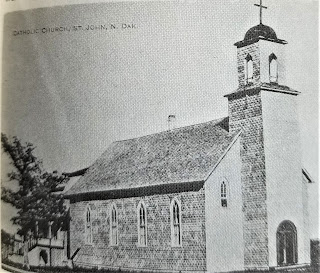
This is the church where my dad, Al Charbonneau, and his cousin, Red Charbonneau, were baptized. It was replaced in the early 1950s by the present church
CONSTRUCTION OF A CHURCH: On April 3, 1888 [sic], Father Malo summoned together his parishioners for advice on the construction of a church and where to locate it. After much deliberation it was [decided to place it] at its present site.  It was decided to build it 30’ wide x 60’ in length and 22 feet in height. At the same meeting, a body of trustees was appointed as follows: Mr. Martin (Customs Officer), B.[Bruno] Charbonneau, A. Foussard, J. Croteau, W. Coghlan, F.X.A. Bourassa [our memoirist] and the Rev. Father Malo, president of this body. We adjourned until Sunday, the 17th, with the agreement that each of us would prepare according to his views a plan with these dimensions suitable for a church. On the 17th we met with our plans. After everyone's examination it was unanimously resolved that my plan be adopted with some modifications in the openings to reduce expenses. Father asked me if I could prepare plans to determine the quantities of materials needed for this construction [and other costs]. I said, "Certainly, I can, but you’re asking me to do a considerable amount of work, especially since anyone can do it, based on this plan, using a scale of a quarter of an inch to the foot. I'm positive that I can execute them perfectly well." "Yes," he told me, "but we have no insight into what the hardware will cost. Do you have an idea of that yourself?" "Yes," I said, "it can't cost less than $900 and can reach $1000.00." Then he said, "Ah, that," Father said, "and then the way to do it." I answered, "I wouldn’t be able to do it for less than $1200.00." He replied, "That’s impossible. You must advise otherwise. I'm going to call on the entire parish to give free work, and everyone will pitch in and we’ll get it done. Money is scarce; but through work everyone can contribute, the Métis as well as the whites. They can bring logs the desired length and size. Others will square them on two sides; others will saw them, making the 2 x 6, 2 x 8, and 10, of desired lengths, the squared footings of oaks on site. Under the circumstances, this is the most economical and practical way." We had to go with that. Most agreed.

Sunday, the 24th, Father revealed that plan to the parish and encouraged those, whose finances were too embarrassed to contribute money, to show up the next day in order to do the work he’d just explained. Indeed, the next day there was confusion regarding the appropriate places for everyone. They succeeded over time. Father made arrangements to have me oversee the work. “Father, I can't,” I protested. “Building the schools made me neglect my farm work. And I plan to build a barn this summer. Maybe my sons can do it. Abdalah or Hector can, with my help from time to time. But none of us wants to supervise this work for less than two dollars a day." Old Jos. Desrochers offered to manage the laborers for a dollar and a half, so he was entrusted with supervision. In June the body [of the church] was elevated . Prior to that date, there had been disputes among the trustees regarding supervision and some points on construction. So much so that [Bruno] Charbonneau withdrew as a trustee by resigning.

After the body of the church was elevated [likely the framing was put together on the ground, then raised like a barn-raising], the walls were constructed (30 x 60 and 22 feet high), without any bracing. [Being made from trimmed logs, cut to fit, the walls were probably built from the ground up.] Martin and I protested, declaring that these large sections would not stand up if they were not solidly braced [with joists]. They ignored our warnings and continued. They had not finished before a great southerly wind arrived, blowing from one side to the other while they were working. They hurriedly braced in several places, managing to keep the walls up. When they had finished tucking, they began to lift the attic as an ordinary barn roof was lifted, having removed all the large [joists or rafters] that made the construction solid, having put only one small [truss?] at two thirds of the height of the rafters with a small cross board, above the [truss?] in the head of the rafters. [Translating French language construction lingo is difficult for the Internet application and for me.] My plan was much simpler, and did not cost half of what the avalanche of wood that old Desrochers added to it, knowing no better than anyone. Martin, seeing this, came to warn me. We summoned the trustees to meet that evening. All were present (minus Charbonneau, no longer wanting to take part). We told them that the fault was in removing the stabilizing force  [trusses?] that held this building upright, that the original plan had what it took, no more, no less, to create a stable building. It was useless.  These old men knew nothing.  Immediately, Martin and I submitted our resignations, no longer wanting to appear to support what was happening. I withdrew, washing my hands of everything that was about to happen. I did not regret my warnings. I had done everything I could to make sure everything was fine. It was without remorse that I withdrew.

They continued and covered the roof. In August we had a strong southerly wind that shifted the building by more than 6 inches. It would have fallen had they not quickly braced six 30-foot-long logs on the north side, holding the church upright. At the beginning of September, we had a strong northwest wind that affected the south side, helped by the braced logs set to the north side. They noticed just as the church was shifting on the south side. Quickly they put logs on that side, as they had in the north. Our good Father Malo began celebrating Mass in this rickety castle, and moved into the addition, his future residence. It was clear as daylight, the church could not last long.
John Ireland (b.1838 Kilkenney Co., Ireland- d.1918), Archbishop of St. Paul, MN
At the end of September, our bishop [John Ireland out of Minnesota] came to visit and summoned [Bruno] Charbonneau, Martin and me to an audience. He wept, this poor bishop, when told the church could not stand, and strongly censored those skilled in construction for having distanced themselves from this construction. It was clear he had summoned us only to admonish us. When he finished, I told him, "Your Excellency, we were forbidden to meddle in the construction. Our opinions were viewed with contempt. Our protests regarding the manner the construction was being executed were also ignored, even by the Rev. Father. Most ignored our warnings of what would happen. And that's it." He said, "Do you think it’s possible to stabilize the church so that it will be safe." "Yes," I said, "but it will never be straight, as it would have been, had they not deviated from the plan." "We know," replied the bishop. "What we want is for you to put your hand and your knowledge into it to stabilize it if possible." "Your Excellency," I said, "this work is difficult to do, it will long be seen that these 22 great trusses of 2 x 8 and 23 feet in length may not come from two cuttings exactly the same length, and the Rev. Father likes to see the work done quickly, and this work cannot be done by steam. Moreover, Your Excellency, I want my original plan submitted to an architect. He will either approve or condemn the parts of my plan they refused to execute during construction." The bishop said to me, "This will be done, Mr. Bourassa, and all these mistakes must no longer be taken into account in doing what is possible to repair things." "I will, Your Excellency, but I desire to see the response received from this architect." He answered, "Father Malo will show it to you." The architect’s answer contained only these words: "This plan is perfect for such a building, there is nothing to remove and nothing to add, only that it was made by a hand without practice." Poor Father Malo, it was hard to see him in such a position. He kept his head down all the time I read the report, saying hardly a word. We got on with the work to be done. He paid me $3.00 a day and dinner, old Chartrand [his big draft horse] to help me. I worked there for 17 days. She stood it, but became hunchbacked. [And here he ended his memoir.]
François and Marie Bourassa
Marie died in 1903 at age 67. François died in 1918 at age 82. Whether he died from the flu pandemic we don't know. St. John did lose about 12 people in that pandemic. 
Alcide, Lindorf, Horace, Hector, Alfred Bourassa. Abdullah not shown, so photo probably taken after his death 1910, possibly 1918 at their father's funeral.
 Of the sons, Abdullah died in St. John in 1910. Alcide died in Radville, Sask. in 1950; Lindorf died in Radville in 1946; Horace died in Daniels Co., MT in 1928; Hector died in St. John in 1939; Alfred died in LaFleche, Sask. in 1943. 
Georgina (Bourassa) Durocher died in 1944 in Kenniwick, Washington.

As for our great-grandmother, Marie Elisa Lumina (Bourassa) Charbonneau, she died in Seattle, Washington, in 1952. Here's a photo of Lumina and her family I haven't posted before. You'll recall she lost our great-grandfather Omer Charbonneau in 1913 at St. John.
c.1936. Dad's father Alfred and Red's father Charles in back row.